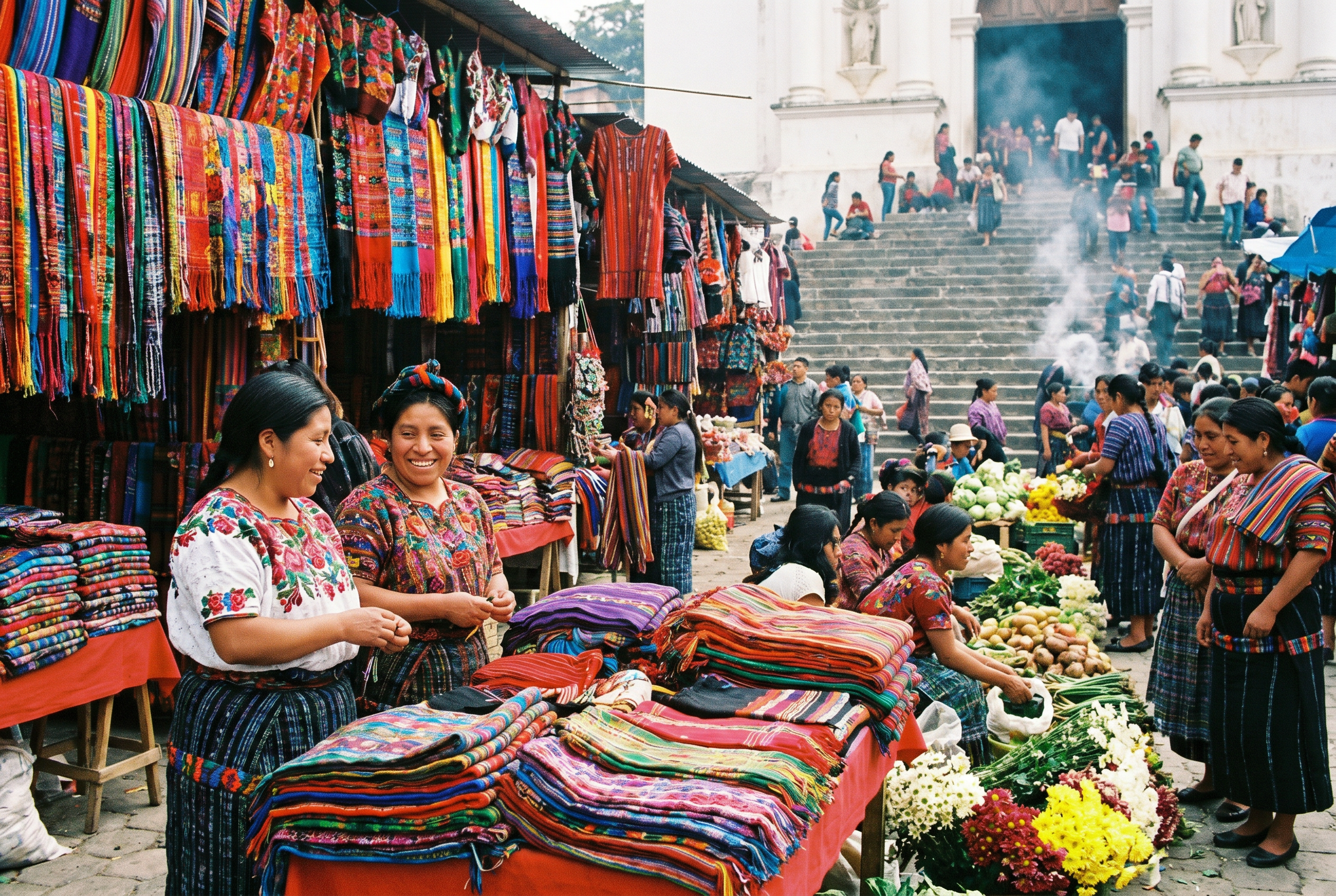
Chichicastenango is home to one of the largest and most authentic indigenous markets in all of Latin America, held every Thursday and Sunday. The market fills the streets surrounding the Santo Tomás Church with textiles, ceramics, flowers, incense, and traditional foods. It is a living expression of K'iche' Maya culture and one of the most visually stunning experiences Guatemala offers.
The market of Chichicastenango — known locally simply as Chichi — has operated continuously for centuries and remains a primary economic and cultural gathering point for the surrounding highland communities. On market days, vendors arrive before dawn from villages throughout the El Quiché region, setting up stalls that cover the church steps, the surrounding streets, and the covered market halls below. The scale and density of the market is overwhelming in the best possible way.
Textiles are the heart of the market. Huipiles, cortes, tzutes, and table runners from communities across the highlands are laid out in stalls that can be difficult to navigate without a sense of what you are looking for. The quality varies enormously — mass-produced pieces sit alongside genuinely handwoven work — and taking time to examine the weave structure, the thread weight, and the consistency of the pattern reveals the difference. The finest pieces come from weavers who have spent years mastering the backstrap loom traditions of their specific community.
The Santo Tomás Church, built in 1545 on the base of a pre-Columbian temple platform, is one of the most remarkable religious spaces in Guatemala. The church steps are used simultaneously for Catholic worship and traditional Maya ceremony — copal incense burns on the steps, flower offerings are laid at the base, and Maya spiritual leaders (ajq'ijab') perform rituals that predate the Spanish arrival. Inside the church, the floor is covered with candles, flowers, and offerings, and the air is thick with incense. Visitors are welcome but should enter quietly and respectfully.
The Museo Rossbach, housed in a colonial building near the church, holds a small but significant collection of pre-Columbian jade, ceramics, and textiles that provides context for the living culture visible in the market outside. The combination of the museum, the market, and the church makes Chichicastenango one of the most layered and rewarding destinations in the Guatemalan highlands.
Heritage & Cultural Context
The Deeper Story
The K'iche' Maya of Chichicastenango are the custodians of one of the most important documents in the pre-Columbian world — the Popol Vuh, the K'iche' Maya creation narrative. The original manuscript was transcribed in the mid-sixteenth century by a K'iche' nobleman and later discovered by a Dominican friar in Chichicastenango. The text describes the creation of the world, the adventures of the Hero Twins, and the origins of the K'iche' people, and it remains a living document in the cultural and spiritual life of the community.
A Note from The Quetzal Collective
Chichicastenango is where the breadth of Guatemalan textile tradition becomes visible in a single place. The range of regional styles, color palettes, and weaving techniques on display in the market reflects the same diversity that The Quetzal Collective draws from in curating its pieces. Coming here with some knowledge of what distinguishes authentic handwoven work from mass production makes the experience significantly richer.