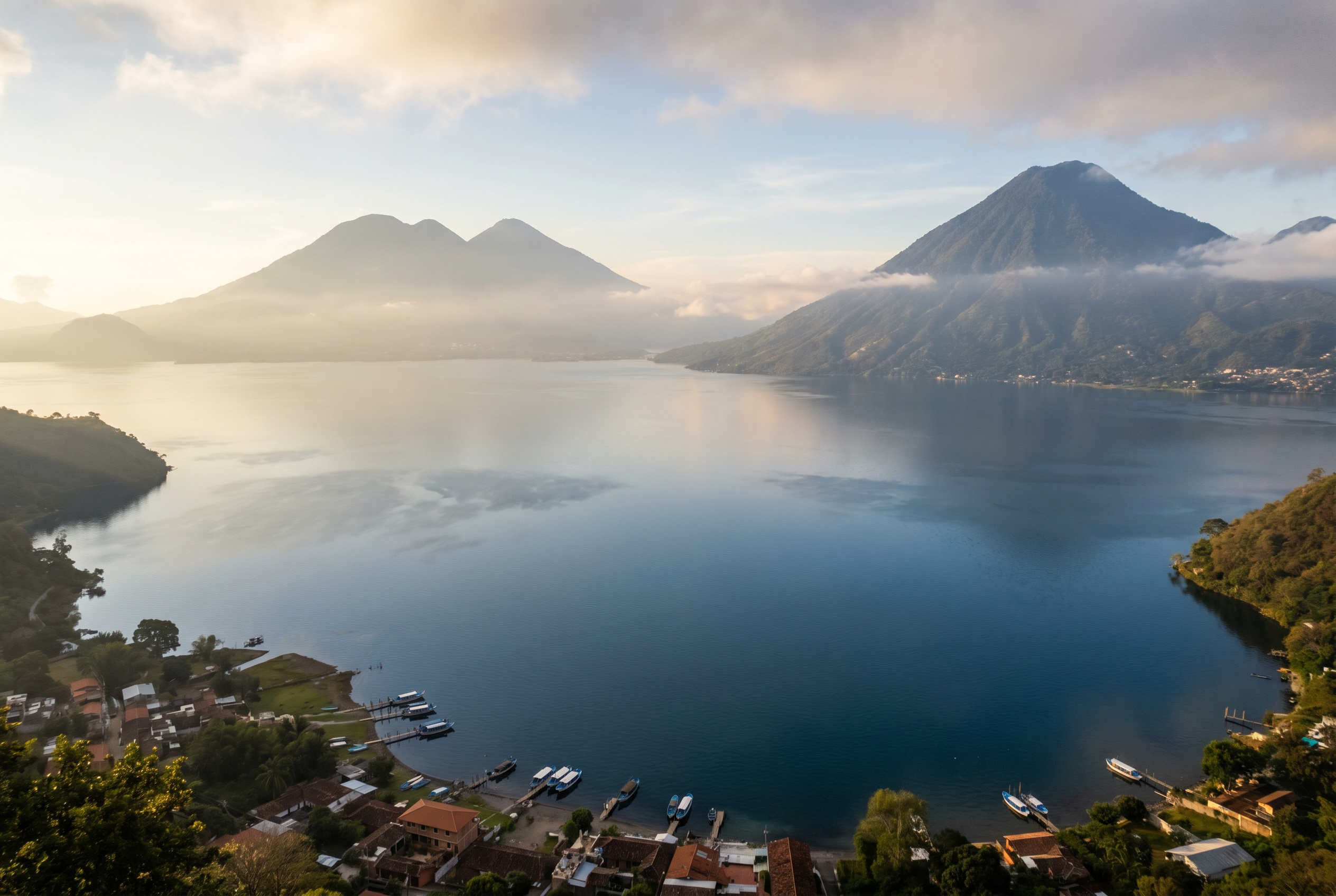
Lake Atitlán is widely considered one of the most beautiful lakes in the world. Formed in a volcanic caldera and surrounded by three volcanoes and a ring of Maya villages, the lake offers a combination of natural grandeur and living indigenous culture that is rare anywhere on earth. Aldous Huxley called it 'too much of a good thing.' He was not wrong.
The lake sits at 1,560 meters above sea level in the Sierra Madre highlands of Guatemala, and its depth — reaching 340 meters in places — gives the water a color that shifts from deep indigo to turquoise depending on the light and the season. The three volcanoes that frame the southern shore — Tolimán, Atitlán, and San Pedro — rise steeply from the water's edge and create a backdrop that makes even the most seasoned traveler stop and stare.
The villages around the lake are the real reason to spend more than a day here. Each community has its own distinct identity, textile tradition, and community structure, and traveling between them by boat — the primary means of transport on the lake — is one of the great pleasures of Guatemalan travel. Santiago Atitlán, the largest town on the lake, is home to the Tz'utujil Maya and the shrine of Maximón, a syncretic deity who combines Catholic and pre-Columbian spiritual elements and is tended by a rotating brotherhood of local men.
San Pedro La Laguna has become a hub for longer-stay travelers and language learners, with Spanish schools, cafés, and a relaxed atmosphere that makes it easy to spend a week without feeling rushed. San Juan La Laguna, a short walk or boat ride away, is the weaving center of the lake — its women's cooperatives produce some of the finest naturally dyed textiles in Guatemala and offer workshops where visitors can learn the backstrap loom technique firsthand.
The lake's ecology is under pressure from population growth, agricultural runoff, and tourism, and several organizations are working to protect the watershed and the communities that depend on it. Choosing locally owned accommodation, eating at family-run restaurants, and buying directly from artisan cooperatives rather than tourist shops all contribute to a more sustainable form of engagement with this extraordinary place.
Heritage & Cultural Context
The Deeper Story
The lake and its surrounding communities have been inhabited by the Tz'utujil and Kaqchikel Maya for thousands of years. The lake itself holds deep spiritual significance in Maya cosmology — it is associated with the underworld, with transformation, and with the cyclical nature of time. The communities around the lake maintain ceremonial calendars, weaving traditions, and linguistic practices that connect them directly to the pre-Columbian world, even as they navigate the pressures of the twenty-first century.
A Note from The Quetzal Collective
San Juan La Laguna is one of the most important sources of naturally dyed, backstrap-loom woven textiles in Guatemala. The cooperatives here use plant-based dyes — indigo, marigold, avocado, and others — to produce colors that are impossible to replicate with synthetic dyes. The Quetzal Collective's commitment to authentic handwoven work is rooted in exactly this kind of tradition.