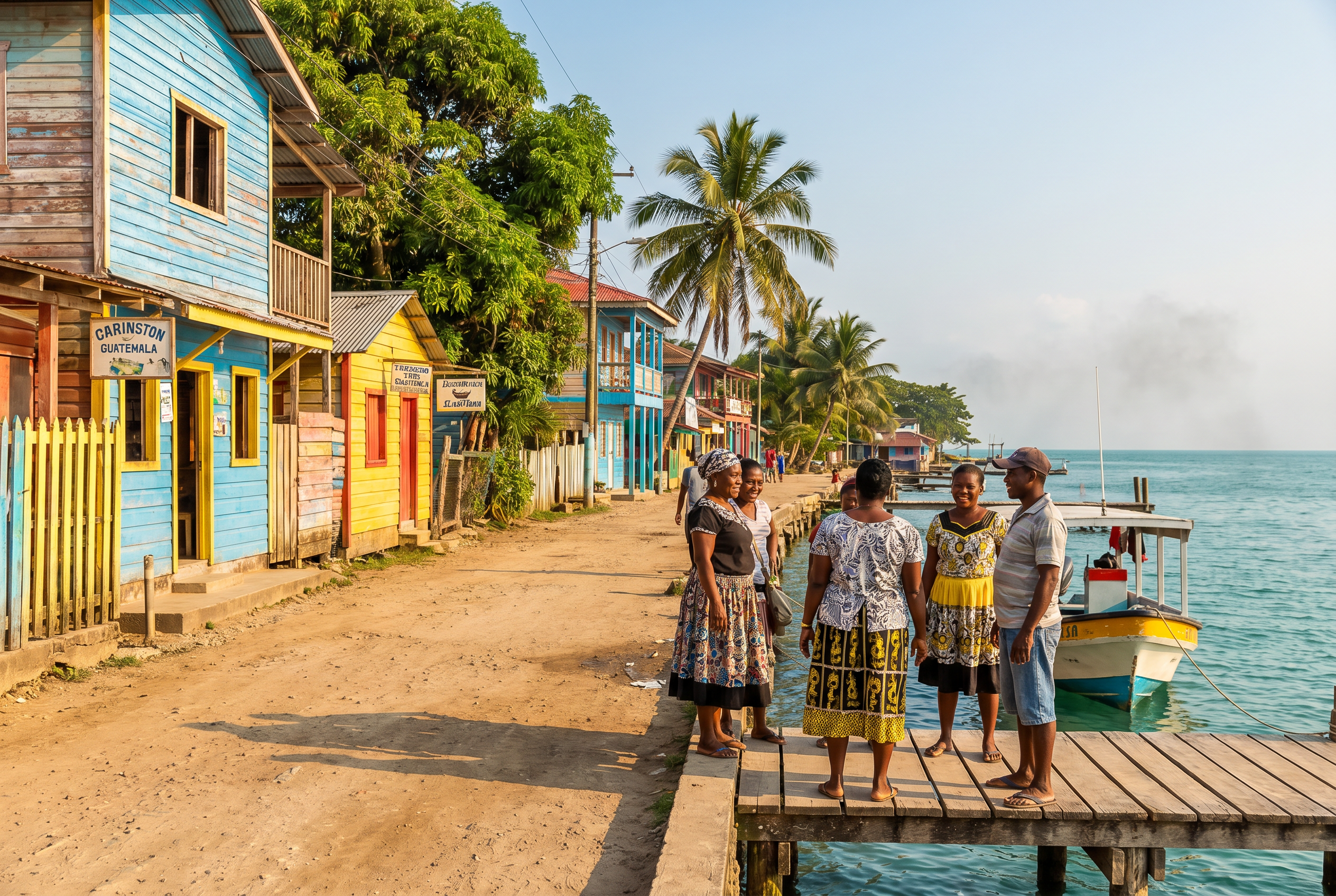
Livingston is unlike anywhere else in Guatemala — a Caribbean town on the country's small Atlantic coast that can only be reached by boat. It is the cultural heart of Guatemala's Garifuna community, a people of African and indigenous Caribbean descent who maintain a distinct language, music, food, and ceremonial tradition. Livingston offers travelers an encounter with a culture that exists nowhere else in the world in quite the same form.
The Garifuna people arrived on the Caribbean coast of Central America in the early nineteenth century following their expulsion from the island of St. Vincent by the British. Their culture blends West African, Arawak, and Carib traditions in a way that is entirely its own — a language that draws from all three sources, a music tradition (punta and paranda) that has influenced Caribbean music broadly, a food culture centered on cassava, coconut, and seafood, and a ceremonial life that includes the Dugu — a multi-day healing ceremony that calls on the spirits of the ancestors.
UNESCO recognized Garifuna language, dance, and music as an Intangible Cultural Heritage of Humanity in 2001, and the designation has helped draw attention to a culture that was at risk of being marginalized by the dominant cultures of the countries where Garifuna communities live. In Livingston, the culture remains vital — the music is played in the streets, the food is cooked in the traditional way, and the language is spoken by the older generations and taught to the younger ones.
Livingston's physical setting is striking. The town sits at the mouth of the Río Dulce, where the river meets the Caribbean, and the combination of the river, the sea, the jungle, and the colorful buildings creates a visual environment that feels genuinely tropical in a way that the highland Guatemala does not. The beaches near Livingston — particularly Playa Blanca and the Siete Altares waterfalls — offer some of the most beautiful natural scenery on Guatemala's Caribbean coast.
The town is small and easy to navigate on foot, and the best way to experience it is slowly — eating at the local restaurants, listening to the music that drifts from the bars in the evening, talking to the people who live there. Livingston rewards patience and curiosity more than any checklist of sights.
Heritage & Cultural Context
The Deeper Story
The Garifuna history is one of the most remarkable stories of cultural survival in the Americas. Descended from the indigenous Caribs of the Lesser Antilles and the enslaved Africans who joined them, the Garifuna maintained their cultural identity through colonial rule, forced displacement, and the pressures of assimilation in multiple countries. The Dugu ceremony — which can last several days and involves the entire community in calling on the spirits of the ancestors — is the most powerful expression of this cultural continuity, a living connection between the present community and all the generations that came before.
A Note from The Quetzal Collective
Livingston represents a dimension of Guatemalan cultural diversity that is often overlooked in favor of the highland Maya traditions. The Quetzal Collective's interest in Guatemala is not limited to the weaving traditions of the western highlands — it extends to the full range of the country's cultural richness, including the Garifuna heritage of the Caribbean coast.