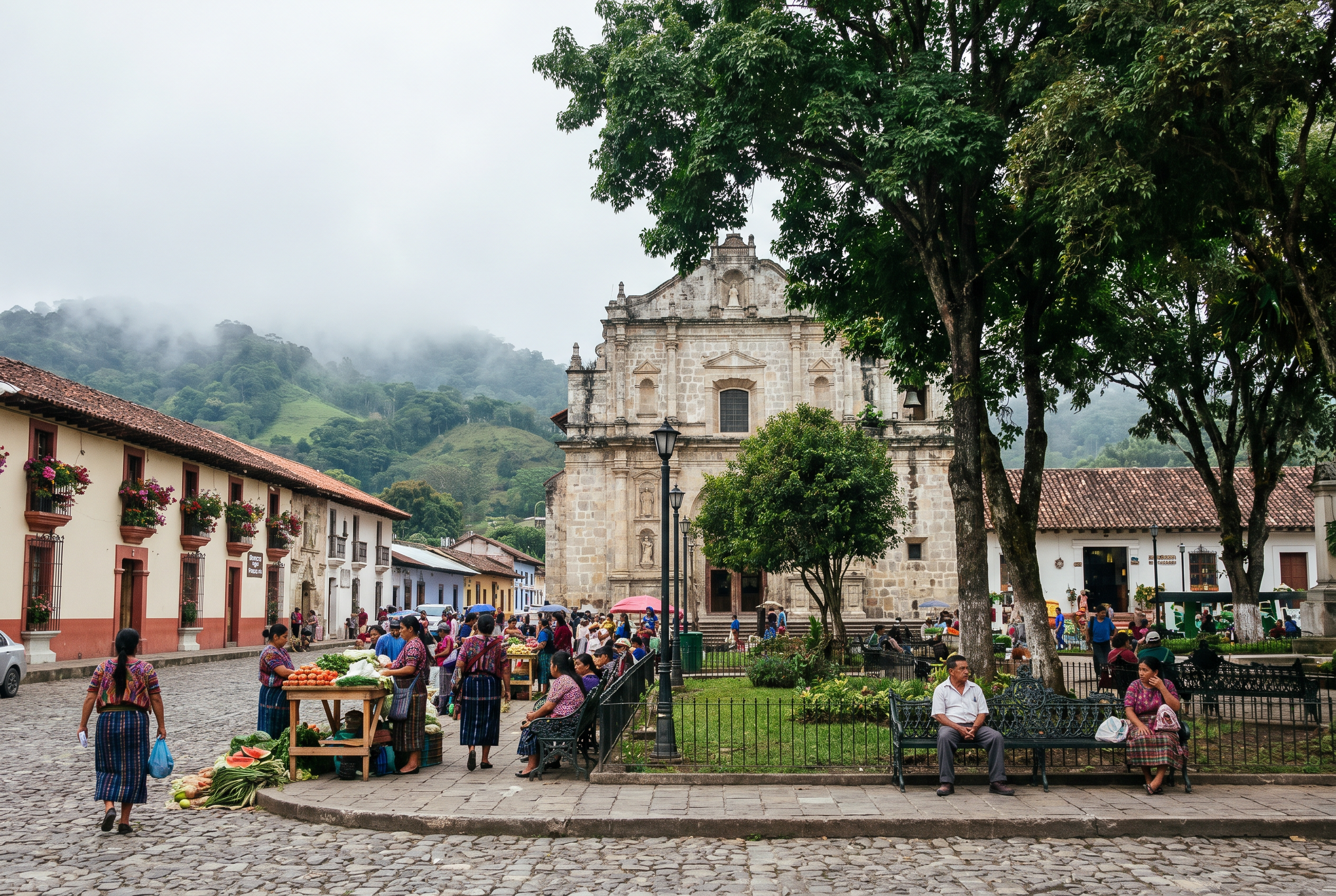
Cobán is the capital of Alta Verapaz and the hub for exploring one of Guatemala's most biologically and culturally rich regions. The city itself has a cool, misty climate — locals call the fine mist that often hangs over the city chipi-chipi — and a strong German colonial influence from the nineteenth-century coffee boom. It serves as the base for visits to Semuc Champey, the Biotopo del Quetzal, and the Q'eqchi' Maya communities of the surrounding highlands.
The German influence on Cobán is one of the more surprising aspects of Guatemalan history. In the mid-nineteenth century, the Guatemalan government actively recruited German immigrants to develop the coffee industry in Alta Verapaz, and by the early twentieth century, German families owned a significant portion of the region's most productive coffee farms. The architecture of Cobán's historic center reflects this influence — the Cathedral, the Central Park, and several of the older commercial buildings have a distinctly European quality that sits alongside the Q'eqchi' Maya culture of the surrounding communities.
The coffee culture of Cobán is worth its own attention. The volcanic soil, altitude, and rainfall of Alta Verapaz produce some of the most celebrated coffee in Guatemala, and the city's cafés and roasteries offer tastings, farm tours, and direct connections to the producers. The Finca Santa Margarita, one of the oldest coffee farms in the region, offers guided tours that cover the entire process from cherry to cup and provide a direct encounter with the agricultural tradition that shaped the region.
The Q'eqchi' Maya market in Cobán is one of the most authentic in the highlands — less visited by tourists than Chichicastenango or the Lake Atitlán markets, and correspondingly more focused on the needs of the local community. Traditional Q'eqchi' textiles, particularly the women's blouses known as po't, are distinctive in their use of color and pattern and represent a weaving tradition that is specific to this region.
Cobán's orchid festival, held each December, celebrates the extraordinary orchid diversity of the Alta Verapaz cloud forests. The region is home to more than 800 orchid species, including the white nun orchid (Lycaste skinneri alba), which is Guatemala's national flower. The festival draws growers and enthusiasts from across the country and offers a concentrated encounter with the botanical richness of the region.
Heritage & Cultural Context
The Deeper Story
Alta Verapaz was never fully conquered by the Spanish through military force. The region was known as Tezulutlán — 'Land of War' — because of the fierce resistance of its indigenous population. The Dominican friar Bartolomé de las Casas proposed an experiment: evangelization through peaceful persuasion rather than military conquest. The experiment succeeded, and the region was renamed Verapaz — 'True Peace.' This history of negotiated rather than forced conversion gave the Q'eqchi' Maya a different relationship to the colonial period and contributed to the cultural continuity visible in the region today.
A Note from The Quetzal Collective
The Q'eqchi' Maya of Alta Verapaz produce textiles that are distinct from the highland weaving traditions of the western Guatemala — different color palettes, different pattern vocabularies, different weaving techniques. Understanding the regional diversity of Guatemalan textile tradition is part of what makes The Quetzal Collective's curation meaningful.